Table of Contents
- Table of Contents
- OTR and WVTR in Packaging: The Short Answer
- What Do the Two Measurements Actually Describe?
- Oxygen Transmission Rate and Its Reporting Units
- Water Vapor Transmission Rate and Its Reporting Units
- Comparison Table: What a Barrier Report Must Specify
- How Does Product Sensitivity Guide the Construction?
- Why Windows, Seals, and Closures Need Separate Review
- How to Validate a Barrier Specification in Five Steps
- Frequently Asked Questions
- Conclusion: Compare Conditions Before Comparing Numbers
- Discuss Your Packaging Specification With QINPACK
OTR and WVTR in packaging are useful measurements for comparing how readily oxygen and water vapor pass through a film or laminate. They are not shelf-life guarantees, so buyers must compare the complete test conditions and then validate the selected pouch under its actual filling, storage and distribution conditions.
Table of Contents
OTR and WVTR in Packaging: The Short Answer
The practical buying question is not simply which film has the smallest number. It is whether the reported result represents the laminate, pouch format, closure and conditions that your product will actually experience. Film data should therefore be treated as one input to a construction decision, followed by finished-pack validation.
What Do the Two Measurements Actually Describe?
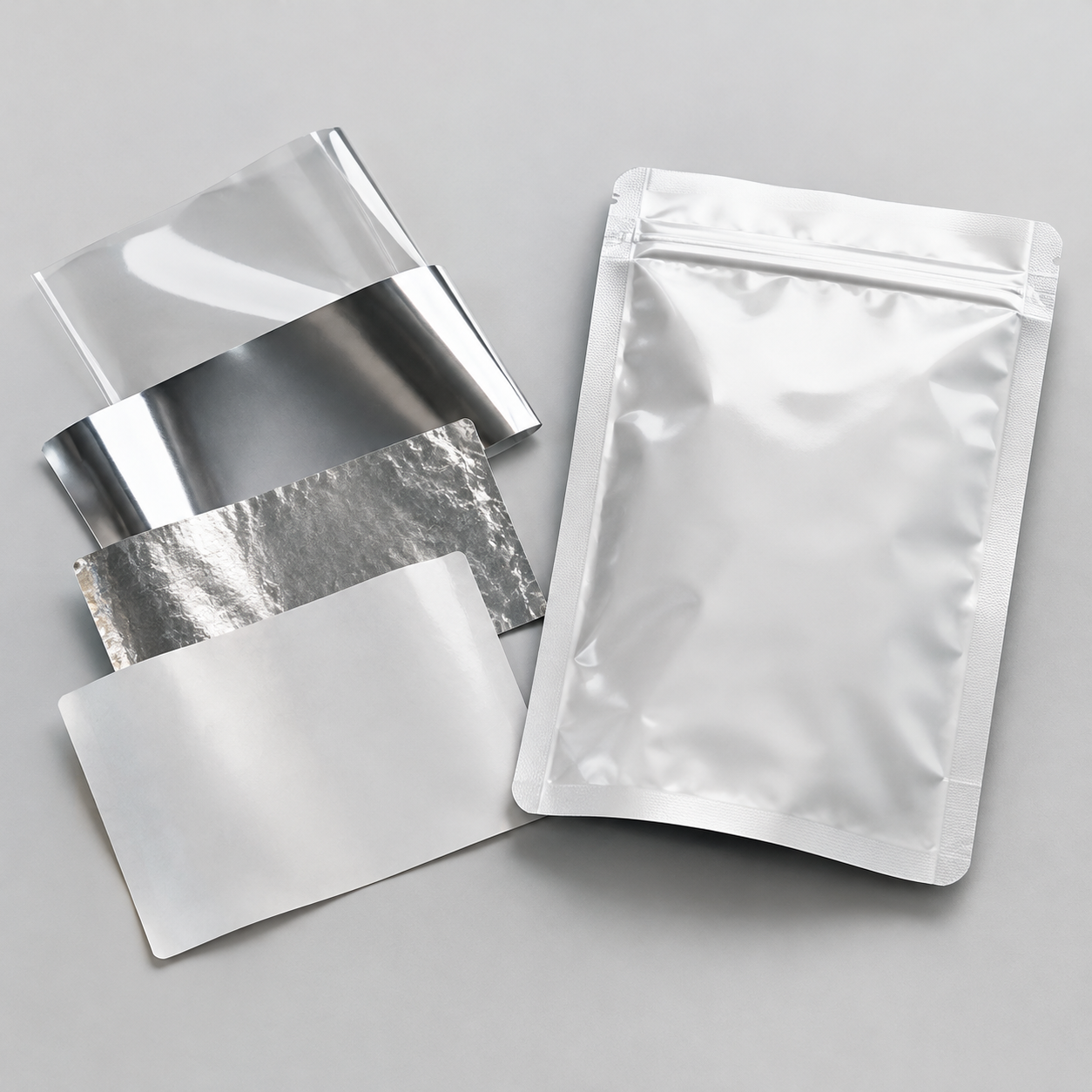
Both measurements describe permeation: the movement of a substance through a material rather than through an obvious hole or failed seal. A test instrument exposes a specimen to specified conditions and measures the amount that passes through it over time. The result is therefore a property of that specimen under those conditions, not a universal label for every pouch made from a similar-looking film.
OTR focuses on oxygen. WVTR focuses on water vapor. They address different risks and should not be substituted for each other. A product may be sensitive to oxidation, moisture pickup, aroma loss, texture change or several of these at once. The relevant barrier priority depends on the product composition, target shelf life, headspace, filling process and storage environment.
Reports also need to distinguish a single film layer from a finished laminate. Lamination, printing, adhesive curing, forming, folding, sealing, zipper installation and fitment insertion can change the construction or introduce discontinuities. A film report can help screen candidate materials, but it does not replace testing or inspection of the finished pack.
Oxygen Transmission Rate and Its Reporting Units
Oxygen transmission rate, or OTR, is the quantity of oxygen that passes through a defined area of a specimen during a defined period. A common reporting form is cm3/(m2 day), where cm3 is the volume of oxygen, m2 is the tested area and day is the time basis.
Read the unit together with the test conditions. The report should identify the test method and revision, specimen construction, nominal or measured thickness, temperature, relative humidity, oxygen concentration or partial-pressure conditions, gas flow or carrier-gas details where relevant, conditioning time and instrument or laboratory information. The result may also include a detection limit or a statement that the rate was below the instrument’s measurable range.
OTR is not the same as oxygen leakage through a pinhole, open seal or damaged closure. Those failure paths are addressed through package integrity and seal evaluation. A low film OTR can coexist with poor whole-pack performance if the pouch has a defect or an unvalidated seal.
Water Vapor Transmission Rate and Its Reporting Units
Water vapor transmission rate, or WVTR, measures the mass of water vapor passing through a defined specimen area during a defined time. The usual unit is g/(m2 day), meaning grams of water vapor per square meter per day under the stated test conditions.
For WVTR, relative humidity on each side of the specimen is especially important. Temperature, humidity difference, specimen thickness, conditioning history, test method, exposed area and instrument details can materially affect the reported value. A result at a dry condition is not automatically comparable with one generated at a higher humidity condition.
WVTR helps buyers assess moisture ingress or loss, but the product response still depends on the formulation and package. Powders, crisp snacks, dried treats and hygroscopic ingredients may respond differently to the same moisture exposure. Use the transmission result with product stability information, headspace considerations and the intended storage profile.
Comparison Table: What a Barrier Report Must Specify
Before ranking two values, place the reports side by side and complete the following fields. If a field is missing, ask for clarification rather than assuming the results are equivalent.
| Report field | What to confirm | Why it matters |
|---|---|---|
| Measurement | OTR or WVTR, with the complete unit | Oxygen and water vapor are different measurements and cannot be compared as one barrier score. |
| Test method | Method name, revision and laboratory or instrument basis | Different methods can use different conditioning and measurement procedures. |
| Specimen | Film, laminate, pouch panel or finished pouch; machine direction where relevant | A single film result may not represent a converted package. |
| Thickness | Total thickness and, where available, individual layer details | Thickness and construction influence transmission and help identify unlike specimens. |
| Temperature | Test temperature in degrees Celsius | Transmission can change with temperature, so values at different temperatures need qualification. |
| Humidity | Relative humidity on the relevant sides of the specimen | Humidity is central to WVTR and can also affect some oxygen-barrier materials. |
| Gas-pressure conditions | Gas composition, partial-pressure difference, flow and carrier-gas conditions where relevant | The driving force and test setup affect the measured rate. |
| Conditioning and time | Specimen conditioning, stabilization and test duration | An unstable result may not represent the intended steady measurement. |
| Uncertainty or limit | Repeatability, detection limit or below-range statement | Very small differences may not be meaningful without measurement context. |
| Application scope | Intended product, storage conditions and validation plan | A material result is not a shelf-life prediction or compliance determination. |
This checklist creates a usable pouch barrier specification. It also gives procurement and engineering teams a common RFQ language: request the value, unit, conditions and specimen identity together.
How Does Product Sensitivity Guide the Construction?
Start with the product’s actual failure modes, not with a preferred material name. Ask what must be protected, for how long, and under which storage and distribution conditions. Oxygen-sensitive products may require attention to oxidation and aroma retention. Moisture-sensitive products may require attention to texture, caking or water loss. Fatty products, acidic products, liquids and powders also place different demands on sealant selection, mechanical strength and filling cleanliness.
Foil, metallized film and EVOH may each be considered as components of a candidate construction, but none should be approved solely because it is described as high barrier. Foil can provide a strong barrier when the complete laminate is properly designed and remains undamaged, while folds, pinholes and conversion damage require review. Metallized films depend on the coating, substrate, handling and laminate design. EVOH is an oxygen-barrier layer whose performance can be influenced by humidity, so the relevant moisture conditions need to be represented in testing. These are engineering considerations, not universal performance rankings.
Format affects the decision as well. A stand-up pouch may need a bottom gusset, zipper, tear feature or fitment. A flat pouch, rollstock format or other geometry can have a different seal layout and exposed area. QINPACK presents stand-up pouch options as a configurable format; the final structure and dimensions still need to be selected against the product and filling process.
For each candidate, document the product composition, fill weight or volume, target shelf life, storage temperature and humidity, distribution exposure, filling temperature, gas flush or vacuum process if used, and expected opening or resealing behavior. This information makes the barrier report relevant to the purchase decision.
Why Windows, Seals, and Closures Need Separate Review
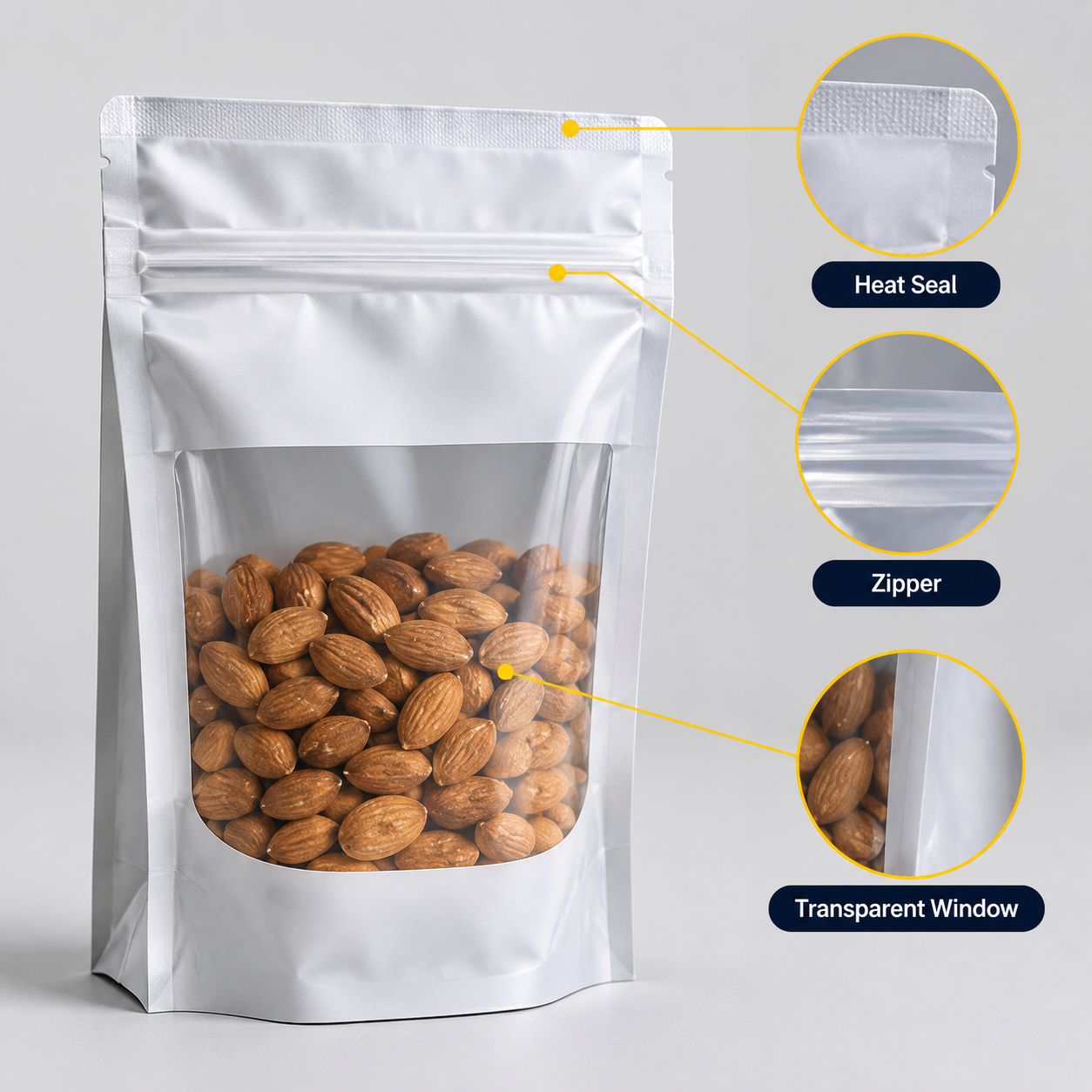
A transparent window can affect whole-pack barrier performance because it may use a different material or create a different construction over part of the package area. Its effect depends on the window material, dimensions, placement, bonding or sealing method, and the barrier requirements of the product. A window does not automatically make a pouch unsuitable, but its contribution should be included in the package review. QINPACK describes transparent window pouch designs as a format option; request the construction details and applicable project evidence for the intended use.
Seals and closures need their own review because OTR and WVTR results from a flat film specimen do not measure a zipper interface, heat-sealed edge, spout fitment, tear notch or corner transition. A pouch can have an appropriate film barrier and still fail through an incompletely sealed area, contamination in the seal, a damaged zipper or a fitment connection. Review sealant compatibility, seal width, seal temperature and dwell conditions, filling contamination risk, closure operation and package handling.
For liquids, powders, vacuum packs and retort or hot-fill applications, the filling and processing conditions may place additional stress on the construction. Do not infer retort compatibility, leak resistance or finished-pack performance from a film OTR or WVTR value alone.
How to Validate a Barrier Specification in Five Steps
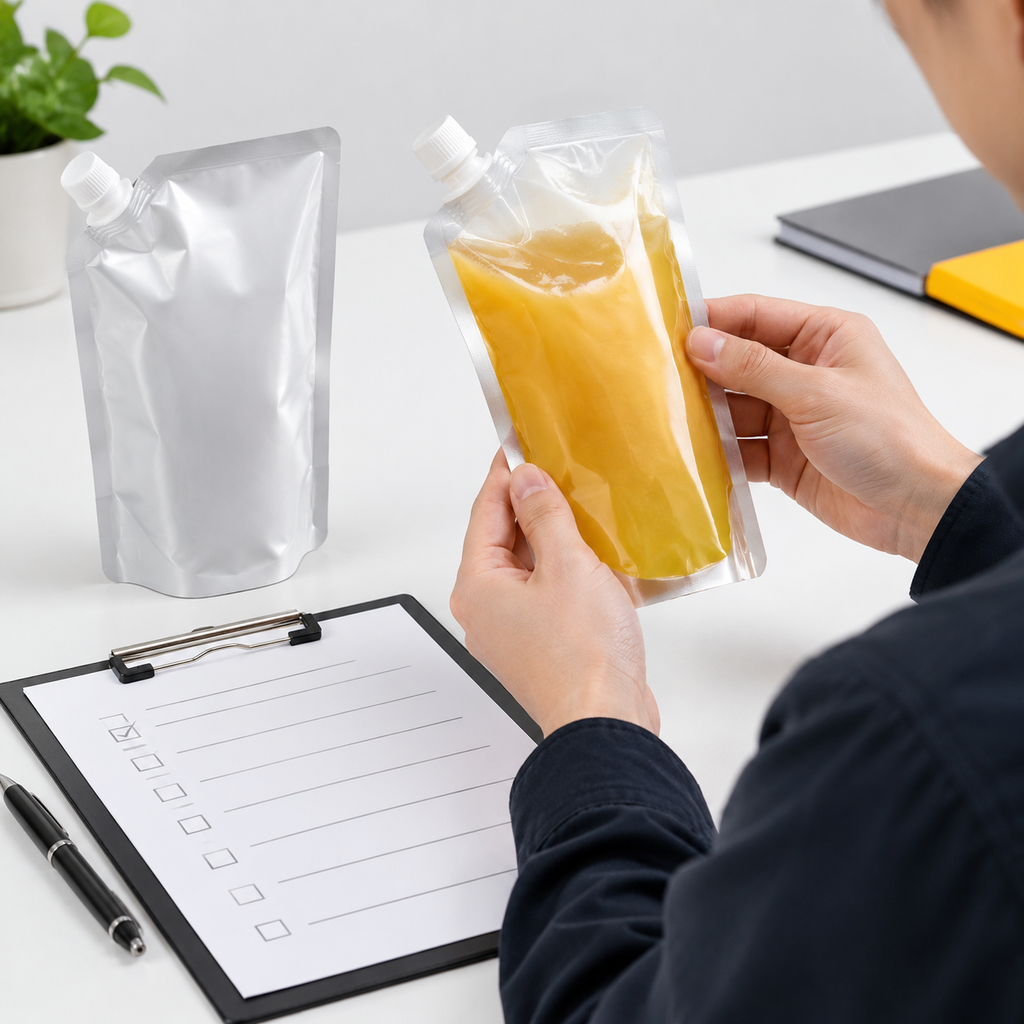
Film comparison is a screening activity. Finished-pack validation confirms whether the selected construction works in the proposed format and application. Use a documented sequence such as the following.
- Define the product and failure mode. Record composition, oxygen or moisture sensitivity, fat or oil content where relevant, fill weight or volume, headspace, target shelf life and acceptable changes in flavor, aroma, texture or appearance. Shelf life must be established through product-specific stability work; it is not created by a pouch alone.
- Define the operating conditions. Record filling temperature, filling equipment, gas flushing or vacuum steps, storage temperature and humidity, distribution profile, stacking, expected handling and any heating or sterilization process. These conditions determine which stresses the finished pack must withstand.
- Request comparable barrier evidence. Ask for OTR and WVTR values with method, unit, thickness, temperature, humidity, pressure conditions, conditioning and specimen identity. Confirm whether the result covers a material, laminate, converted panel or finished pouch. Do not compare a nominal value with a result below a detection limit as though they were identical measurements.
- Review the complete package architecture. Check the barrier layers, sealant, print and adhesive system, gusset or corner geometry, window, zipper, valve, spout or other fitment. Review artwork boundaries and seal areas so that printing or contamination does not enter the seal zone.
- Test representative filled packs. Depending on the application, the validation plan may include finished-pack OTR or WVTR, seal-strength testing, leak or package-integrity testing, visual inspection, dimensional checks, distribution simulation, conditioning and product stability work. Choose methods and acceptance criteria with the responsible technical team. QINPACK’s quality information describes inspection and testing activities published by the company; request the applicable project scope, records and sample requirements for your order.
Use the results to approve a construction and process window, not merely a material name. Record the approved thickness, laminate structure, pouch dimensions, closure, seal parameters, filling conditions and validation evidence in the purchasing specification. Any later change to material, supplier, thickness, window, closure or processing should trigger a change assessment.
Frequently Asked Questions
The answers below summarize the main purchasing decisions when reviewing an oxygen and moisture barrier report.
- What is the difference between OTR and WVTR in packaging?
- OTR measures oxygen transmission through a defined specimen under specified conditions. WVTR measures water vapor transmission. They use different substances, units and test conditions, so one does not replace the other.
- Which test conditions must match before two barrier reports can be compared?
- Match the test method and revision, specimen type and thickness, temperature, relative humidity, gas composition or pressure conditions, conditioning procedure, test duration, exposed area, units and measurement limits. Also confirm whether each result covers film, laminate or finished pouch.
- Do lower OTR and WVTR values guarantee a longer shelf life?
- No. Lower measured transmission can indicate less permeation under that test setup, but shelf life also depends on the product, fill process, headspace, seals, closures, package defects, storage profile and product stability. Finished-pack validation is still needed.
- Can a transparent window affect a pouch’s barrier performance?
- Yes. A window may use a different material or construction and can represent part of the total package area. Review its material, dimensions, attachment, seals and the complete pack rather than judging the window by appearance alone.
- What finished-pack testing should follow a film barrier comparison?
- The plan may include finished-pack OTR or WVTR, seal-strength and package-integrity testing, visual and dimensional inspection, distribution simulation, conditioning and product stability work. The exact tests and acceptance criteria should reflect the product and validated application conditions.
Conclusion: Compare Conditions Before Comparing Numbers
OTR and WVTR are valuable tools for narrowing flexible-packaging constructions, but the numbers only become meaningful when their methods and conditions are visible. Compare like with like: the same type of specimen, relevant thickness, temperature, humidity, gas-pressure conditions, conditioning and reporting basis.
Then move from film data to the complete package. Consider the product’s sensitivity, format, window, seals, closure and filling process, followed by finished-pack and product-specific validation. This approach helps procurement teams avoid approving a material claim that does not represent the pouch used in production.
Discuss Your Packaging Specification With QINPACK
Send QINPACK your product type, fill weight or volume, pouch format and dimensions, target shelf life, storage and filling conditions, order quantity per SKU, artwork requirements, closure needs and destination. The team can discuss a suitable structure, printing method, pouch configuration and project-specific factory quote, along with the information needed for a structure and validation review.
When requesting samples or a dieline discussion, confirm the available sample contents, eligibility, freight charges, artwork proof or prototype scope and the expected production schedule with the team.
FAQ
What is the difference between OTR and WVTR in packaging?
OTR measures oxygen transmission through a defined specimen under specified conditions. WVTR measures water vapor transmission. They use different substances, units and test conditions, so one does not replace the other.
Which test conditions must match before two barrier reports can be compared?
Match the test method and revision, specimen type and thickness, temperature, relative humidity, gas composition or pressure conditions, conditioning procedure, test duration, exposed area, units and measurement limits. Also confirm whether each result covers film, laminate or finished pouch.
Do lower OTR and WVTR values guarantee a longer shelf life?
No. Lower measured transmission can indicate less permeation under that test setup, but shelf life also depends on the product, fill process, headspace, seals, closures, package defects, storage profile and product stability. Finished-pack validation is still needed.
Can a transparent window affect a pouch's barrier performance?
Yes. A window may use a different material or construction and can represent part of the total package area. Review its material, dimensions, attachment, seals and the complete pack rather than judging the window by appearance alone.
What finished-pack testing should follow a film barrier comparison?
The plan may include finished-pack OTR or WVTR, seal-strength and package-integrity testing, visual and dimensional inspection, distribution simulation, conditioning and product stability work. The exact tests and acceptance criteria should reflect the product and validated application conditions.
Discuss Your Packaging Specification With QINPACK
Send your product type, fill weight or volume, pouch format and dimensions, filling and storage conditions, target shelf life, order quantity per SKU, artwork requirements, closure needs and destination. QINPACK can discuss a suitable barrier structure, format, closure, printing method and project-specific factory quote. Include any available OTR or WVTR reports so the team can help identify missing conditions and plan a structure-validation discussion.
Ask the team about available samples, dieline consultation, sample contents, eligibility, freight charges, artwork proofs, prototype scope and production scheduling.
Have Questions About This Packaging Specification?
Send your required barrier barrier properties, filling temperature, or bag dimensions to our Guangzhou prepress engineering team for a formal technical consultation.